2026 SURVEY DATA

SMB lead generation statistics 2026

Key findings from the 2026 Lead-Gen & Conversion Report by Borrell, with inTandem by vcita. 134 US small and midsize businesses shared how they find leads, how fast they respond, what each customer costs them and why so many are ready to switch providers.

The 2026 SMB lead-gen and conversion report by inTandem and Borrell

KEY FINDINGS

The 2026 numbers at a glance

42%

of SMB marketing effort goes to winning new customers, up from 35% in 2022

28%

rate their lead-gen results above average, down from 48% in 2017

77%

report at least one lead-gen challenge

48%

have no formal process for tracking and organizing leads

62%

of after-hours leads wait until the next business day for a reply

38%

would switch to a lead-gen provider that proves a better return

Summary: more effort, less confidence

SMBs are putting more into finding new customers, but fewer of them believe it is working. That is the main conclusion of Borrell’s September 2026 SMB Panel Survey, run with inTandem by vcita. Borrell has run its monthly SMB panel since 2016 and covered lead-gen and conversion in 2017 and 2022, so the 2026 results show how things have changed.

Acquisition is up, confidence is down. Customer acquisition took 42% of SMB marketing effort in 2026, compared with 35% in 2022. Yet only 28% rate their acquisition results above average, down from 48% in 2017.

Social media leads paid lead-gen. 61% of SMBs use social media advertising to find customers, ahead of paid search and SEO at 36% each. Facebook leads in both usage and lead quality, and Instagram use climbed from 26% to 40% since 2022.

The process behind the leads is loose. SMBs handle 84% of lead-gen work in-house, yet 48% have no formal process for tracking leads and 25% don’t track where leads come from.

Results leave room to improve. 77% report challenges, with lead volume, ROI measurement, cost and lead quality drawing similar concern. 38% would likely switch providers for a clearly better return. SMBs want better-qualified leads, clearer measurement and more consistent follow-up.

SMBs are putting more effort into winning new customers

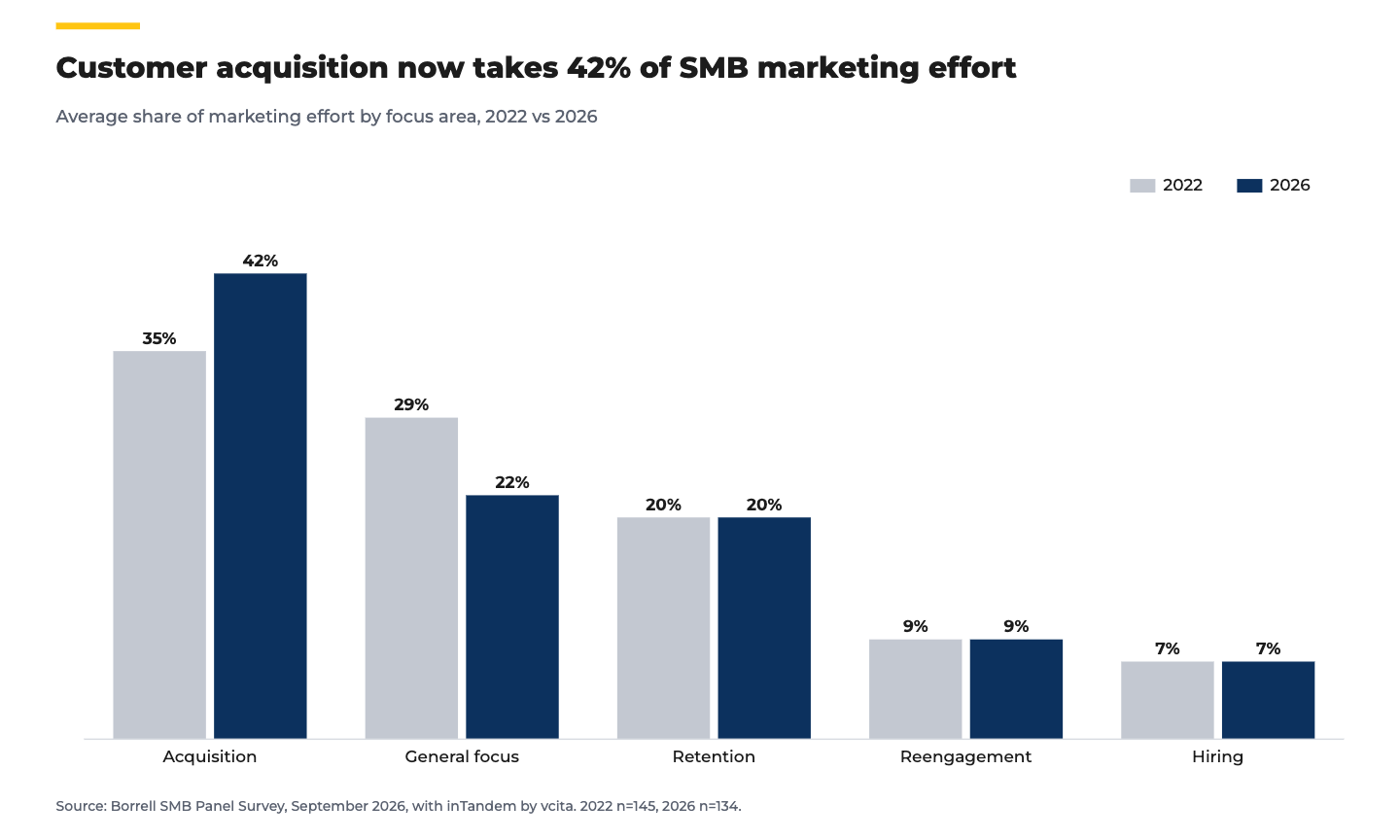
On average, SMBs spent 42% of their 2026 marketing effort on acquiring new customers, up from 35% in 2022. Retention held at 20%, reengagement at 9% and hiring at 7%, while general marketing focus fell from 29% to 22%.

Bar chart: SMBs put 42% of marketing effort into customer acquisition in 2026, up from 35% in 2022. General focus 22% (29%), retention 20% (20%), reengagement 9% (9%), hiring 7% (7%).

90% of SMBs put at least some focus on acquisition (89% in 2022), and 43% spend more than half of their marketing effort on it, up from 31% in 2022.

Among SMBs focused on acquisition, 49% plan to focus even more on it in the coming year, the same rate as in 2022. Their top reasons are the need to raise general awareness (53%), more competition (37%) and a customer base that isn’t big enough to sustain the business (36%). In open answers, the biggest theme was replacing lost revenue or customers.

SMBs with no acquisition focus mostly say they lack the budget or don’t need to grow. As one put it: “We have more work than we can handle.”

Confidence in lead-gen results dropped from 48% to 28%

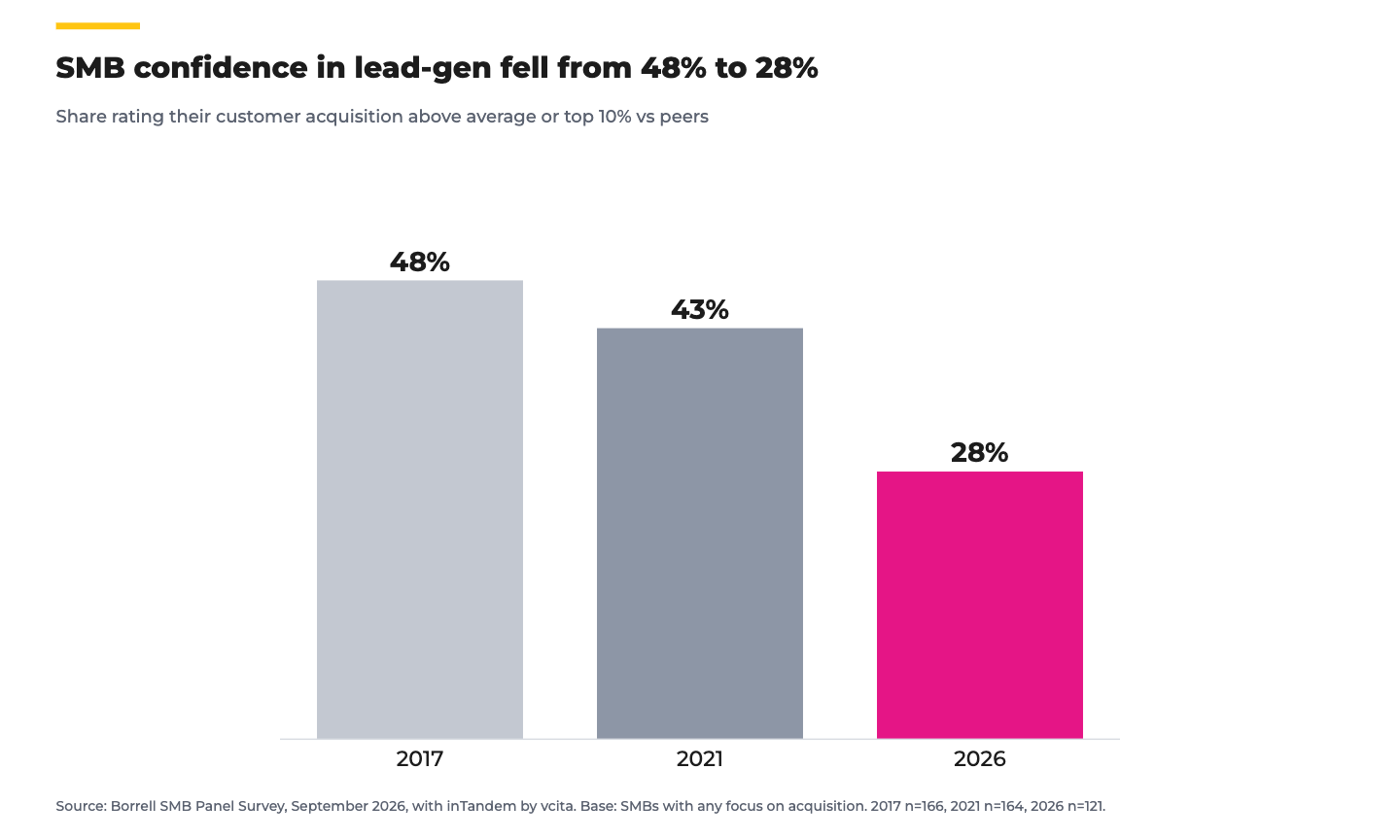
In 2017, 48% of Borrell’s SMB panelists rated their customer acquisition above average or in the top 10% compared with industry peers. That fell to 43% in 2021 and 28% in 2026. The share who rate themselves average rose from 31% to 44%, and 11% now say they don’t know.

Bar chart: 48% of SMBs rated their customer acquisition above average in 2017, 43% in 2021 and 28% in 2026.

Social media is the top paid source of SMB leads

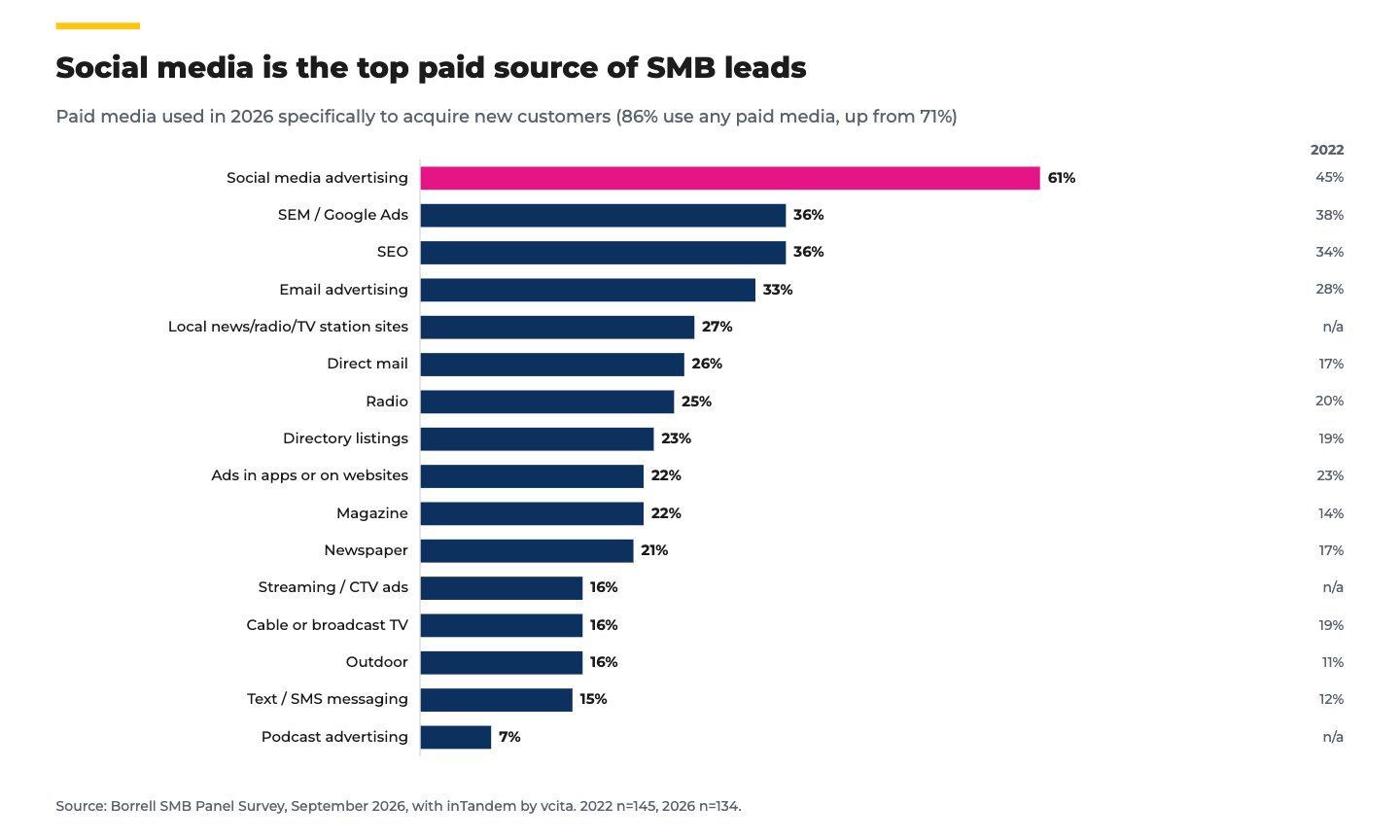
86% of SMBs used paid media to acquire customers in 2026, up from 71% in 2022. Social media advertising leads at 61% (45% in 2022), followed by SEM/Google Ads (36%), SEO (36%) and email advertising (33%).

Traditional media still plays a role. Use rose since 2022 for direct mail (17% to 26%), radio (20% to 25%), magazines (14% to 22%), newspapers (17% to 21%) and outdoor (11% to 16%). 27% of SMBs use local news, radio or TV station websites to find customers.

Bar chart of paid media SMBs use for lead generation in 2026: social media 61%, SEM/Google Ads 36%, SEO 36%, email advertising 33%, local news/radio/TV station websites 27%, direct mail 26%, radio 25%, directory listings 23%, ads in apps or websites 22%, magazine 22%, newspaper 21%, CTV 16%, cable or broadcast TV 16%, outdoor 16%, SMS 15%, podcasts 7%.

Facebook and Instagram dominate social lead-gen

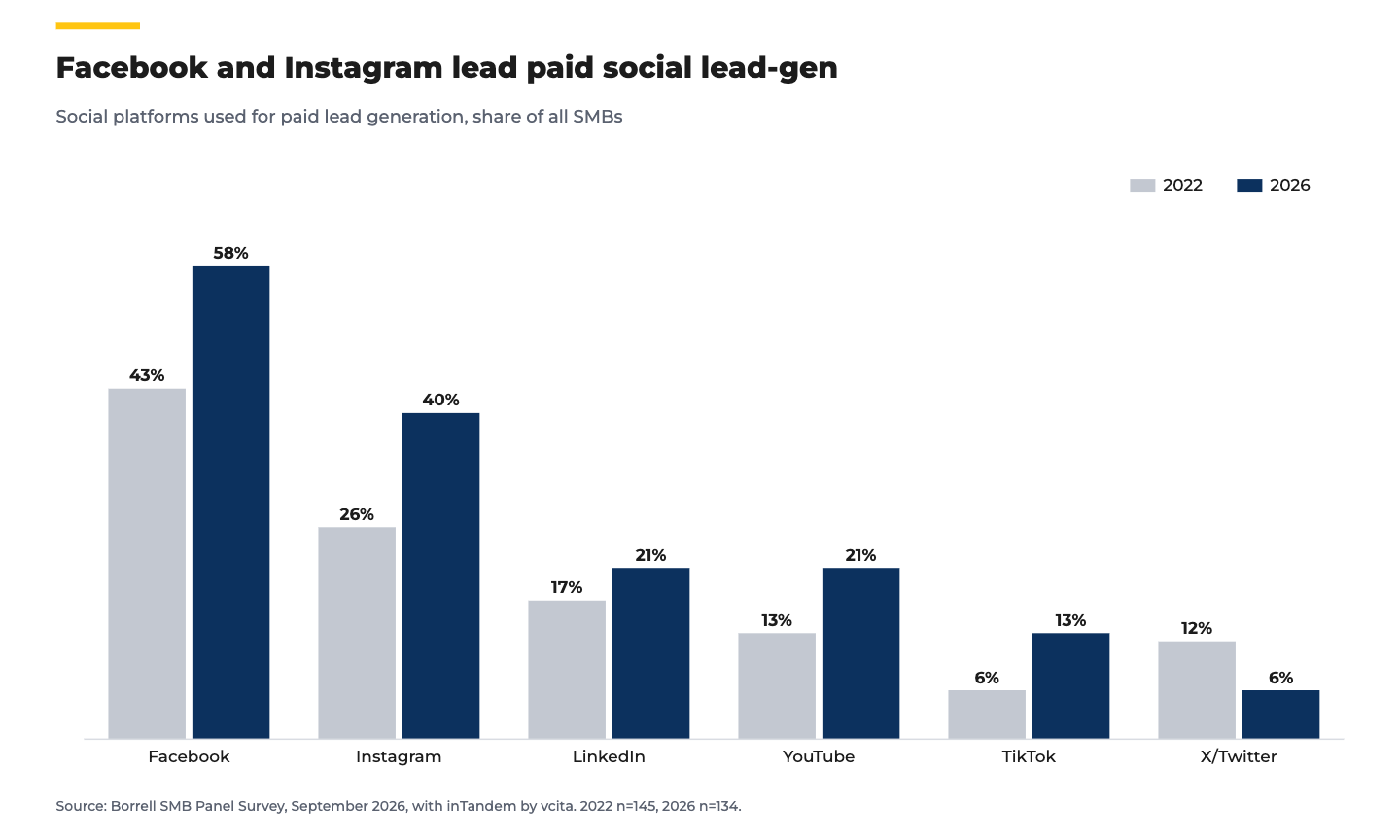
58% of SMBs use Facebook for paid lead generation, up from 43% in 2022. Instagram grew the most, from 26% to 40%. LinkedIn (21%), YouTube (21%) and TikTok (13%) also grew, while X/Twitter fell from 12% to 6%.

Bar chart: Facebook used by 58% of SMBs for paid lead generation (43% in 2022), Instagram 40% (26%), LinkedIn 21% (17%), YouTube 21% (13%), TikTok 13% (6%), X/Twitter 6% (12%).

Beyond paid media, the most common ways SMBs look for new customers are asking for referrals (49%), encouraging online reviews (40%), trade shows and industry events (38%), community partnerships (36%) and new-customer promotions (34%). Emails to a targeted prospect list dropped from 43% in 2022 to 31%. 13% now use AI tools such as chatbots, AI-generated outreach or automatic lead qualification.

Most SMBs handle leads in-house, often without a process

On average, SMBs handle 84% of their lead-gen work in-house and 16% through an outside agency, freelancer or marketing vendor.

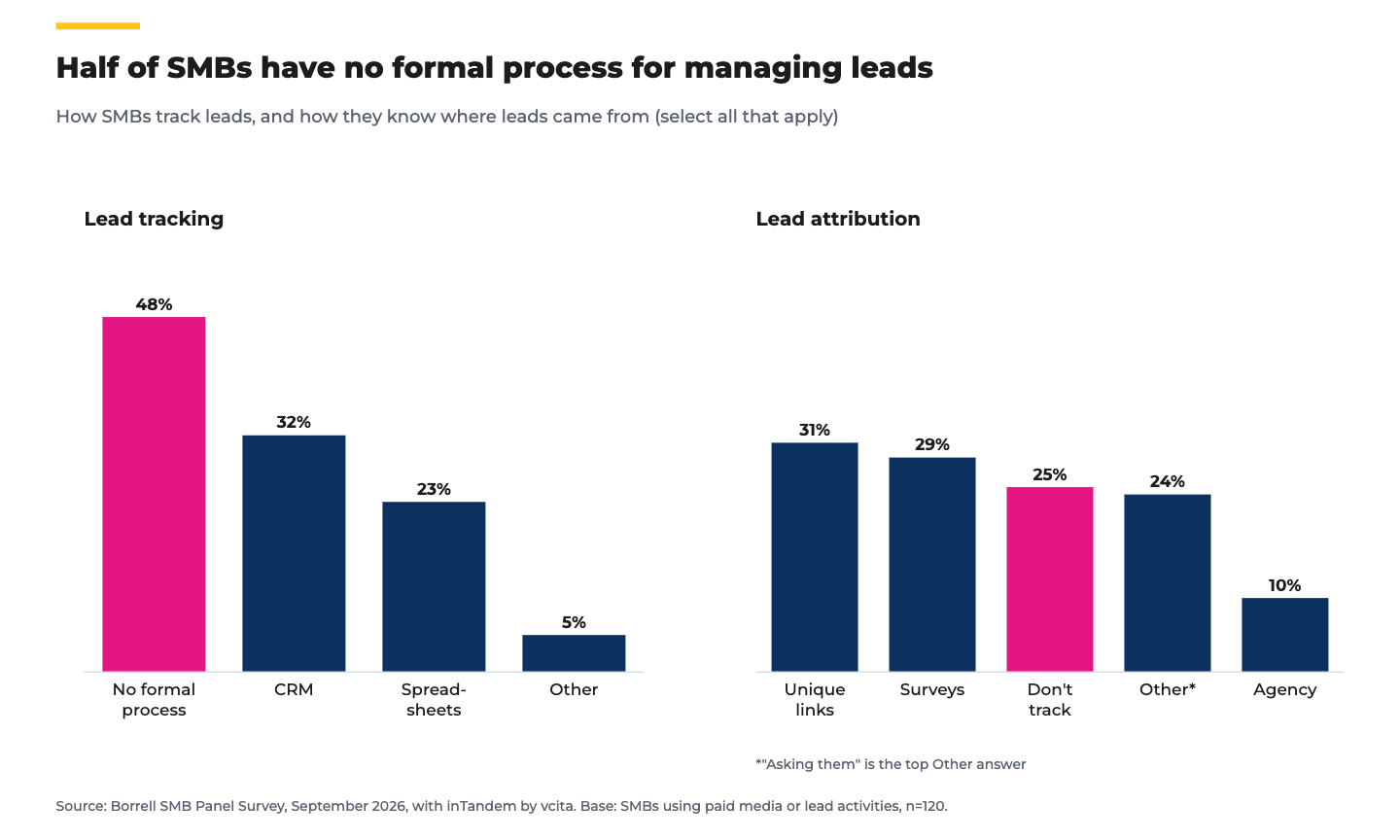
48% have no formal process for tracking and organizing leads. 32% use a CRM or contact database and 23% use spreadsheets.

Two bar charts. Lead tracking: 48% no formal process, 32% CRM, 23% spreadsheets, 5% other. Lead attribution: 31% unique tracking links, 29% surveys, 25% do not track, 24% other (mostly asking the lead), 10% outsourced to an agency.

25% don’t track where their leads come from. Those who do mostly use unique tracking links (31%) or surveys (29%), and “asking them” is the most common other method. 10% leave attribution to an agency or service.

SMBs prefer leads to reach them by email (78%), phone (61%) and website form (43%), ahead of social media messages (18%), SMS (16%) and website chat (12%).

Speed to lead: same-day replies, but after-hours leads wait

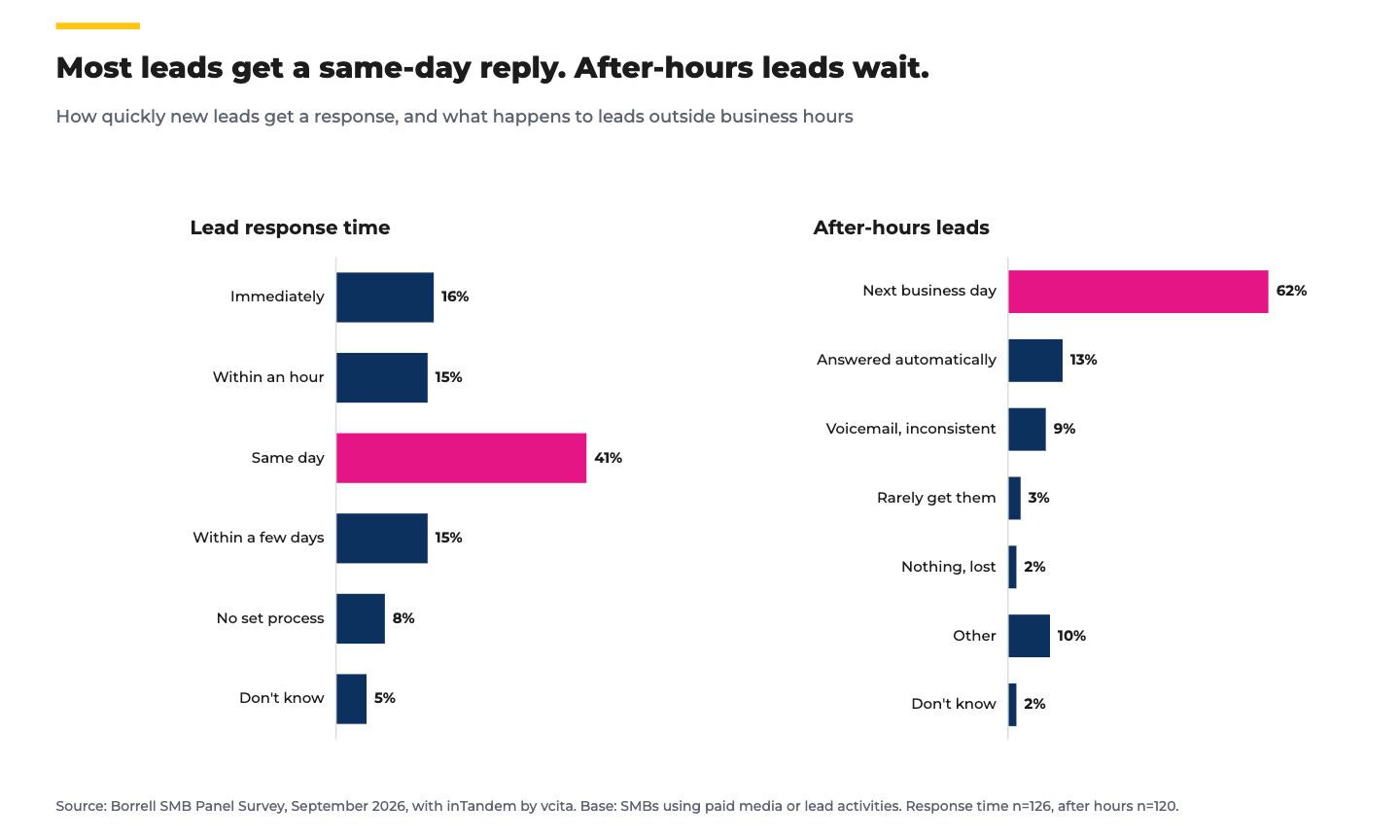
72% of SMBs respond to new leads the same day or faster: 16% immediately, 15% within an hour and 41% later the same day. 15% take a few days and 8% have no set process.

62% of after-hours leads are answered the next business day. Only 13% are answered automatically by a chatbot, autoreply or answering service. 9% go to voicemail with inconsistent follow-up and 2% are usually lost.

Two bar charts. Lead response time: 16% immediately, 15% within an hour, 41% same day, 15% within a few days, 8% no set process, 5% do not know. After-hours leads: 62% answered the next business day, 13% answered automatically, 9% voicemail with inconsistent follow-up, 3% rarely get them, 2% lost, 10% other, 2% do not know.

36% of SMBs have a dedicated employee for leads, 22% route leads to an assigned employee and 20% rely on whoever is available. Only 1% use a fully automated process. 43% spend 1 to 4 hours a week responding to and following up with leads, 25% spend less than an hour and 11% spend 10 hours or more.

48% see no barrier to following up. The rest point to missing information (22%), spam leads (21%), leads that arrive when they’re busy (18%) and after-hours leads (16%). 38% are somewhat or very likely to invest in a solution that helps them respond faster and stops leads from slipping through the cracks.

Get the full 2026 Lead-Gen & Conversion Report

77% of SMBs report a lead-gen challenge

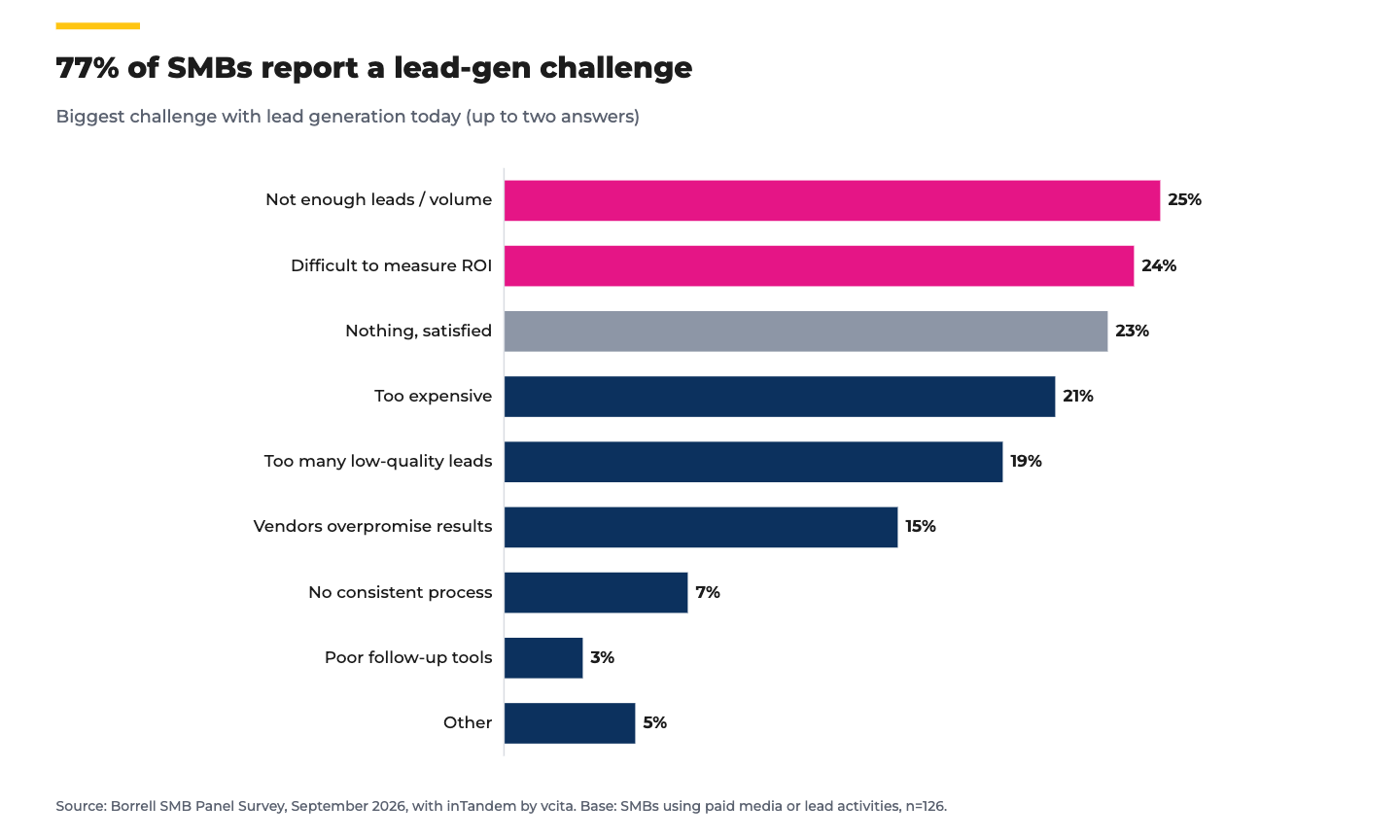
Only 23% say they’re satisfied with their current approach. The top challenges are not enough leads (25%), difficulty measuring ROI (24%), cost (21%) and too many low-quality or unqualified leads (19%). 15% say vendors and platforms overpromise results.

Bar chart of the biggest SMB lead-gen challenges: not enough leads 25%, difficult to measure ROI 24%, nothing (satisfied) 23%, too expensive 21%, too many low-quality leads 19%, vendors overpromise results 15%, no consistent process 7%, poor follow-up tools 3%, other 5%.

The typical SMB gets 14 leads a month from paid lead-gen (median). 34% get fewer than 10, while 14% get 100 or more. 25% don’t know or don’t track it.

Facebook brings the best-quality leads

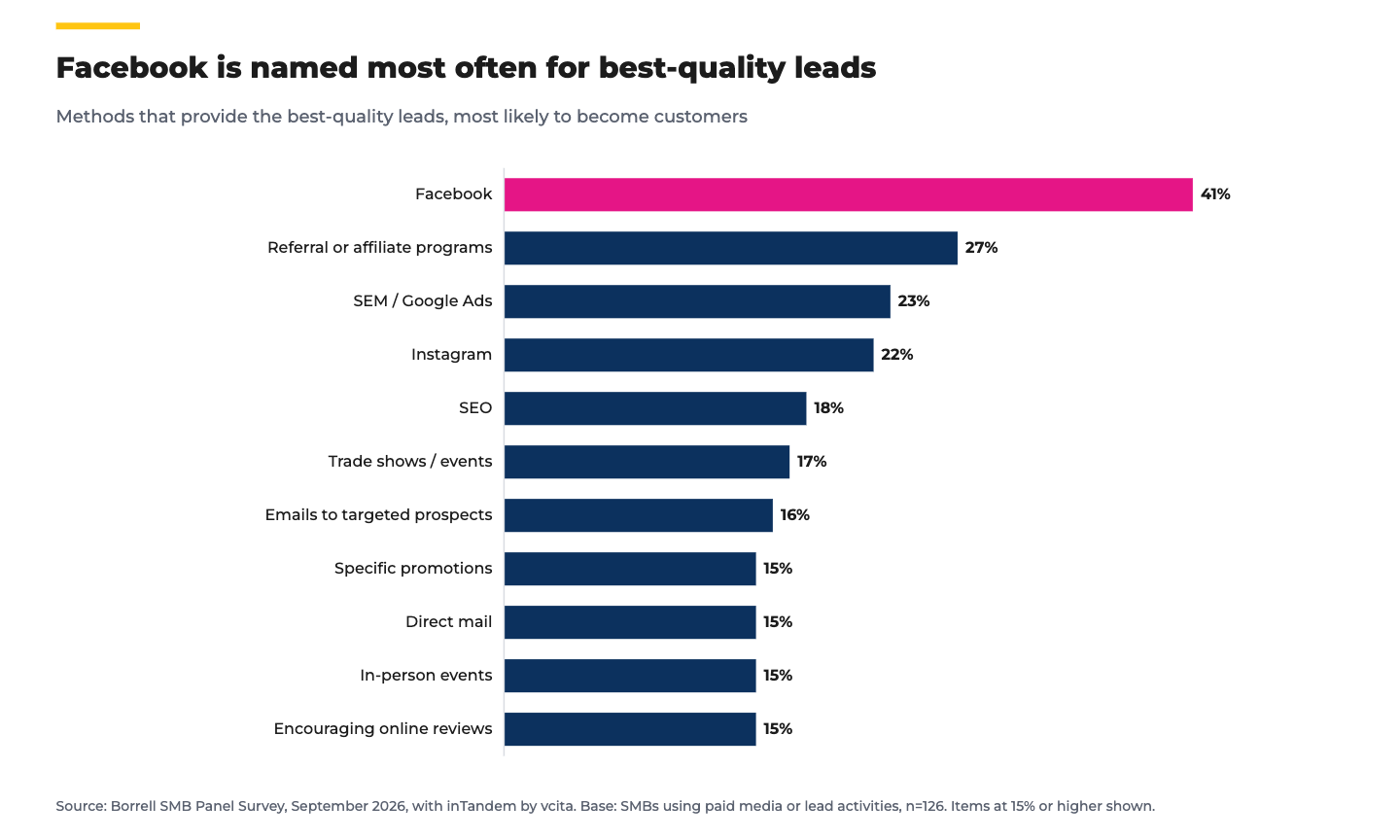
Asked which methods bring the leads most likely to become customers, SMBs named Facebook (41%), referral or affiliate programs (27%), SEM/Google Ads (23%), Instagram (22%) and SEO (18%). Trade shows (17%), targeted prospect emails (16%), promotions, direct mail, in-person events and online reviews (15% each) follow.

Bar chart of sources SMBs say bring the best-quality leads: Facebook 41%, referral or affiliate programs 27%, SEM/Google Ads 23%, Instagram 22%, SEO 18%, trade shows 17%, targeted prospect emails 16%, promotions 15%, direct mail 15%, in-person events 15%, encouraging online reviews 15%.

Lead conversion averages 41%, and 38% would switch providers

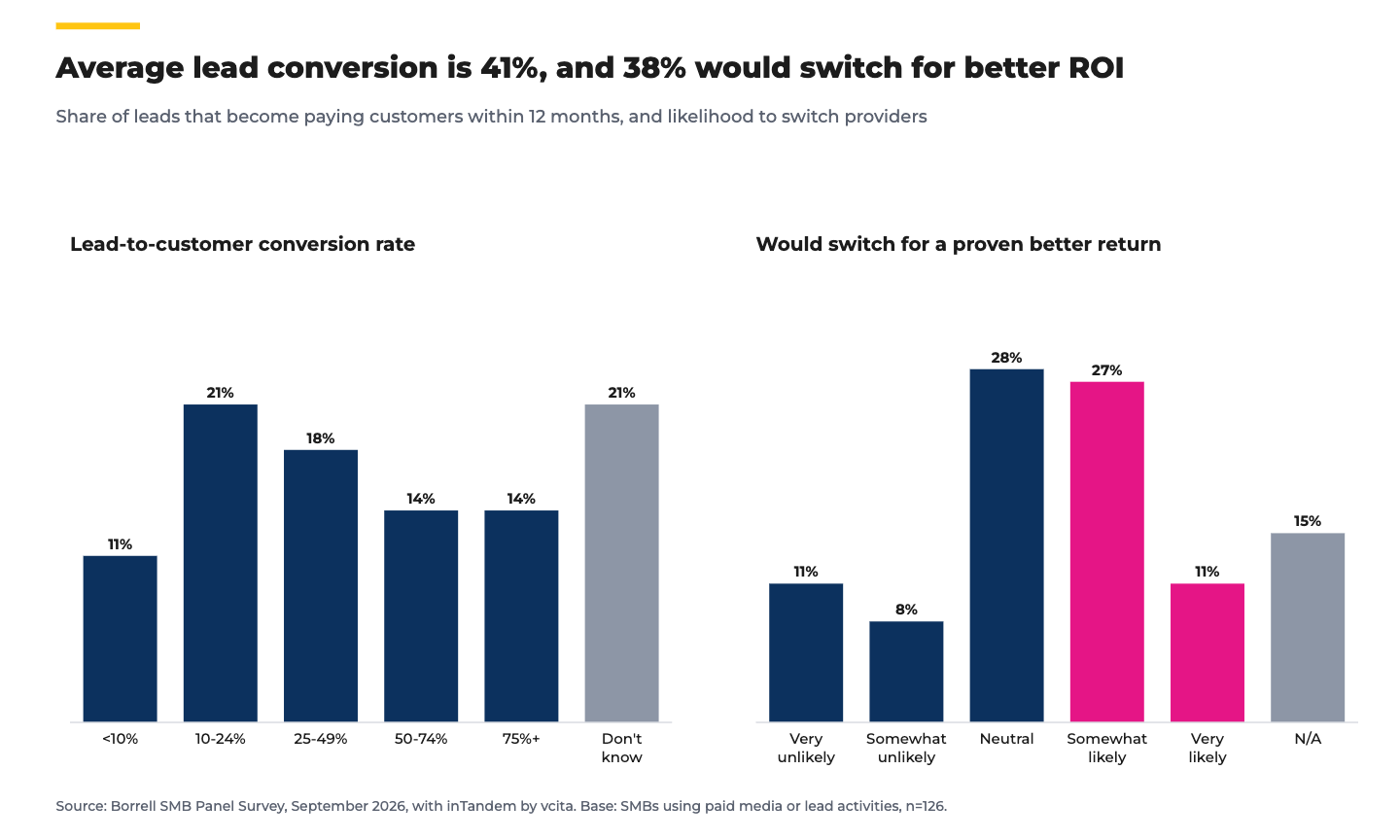
On average, SMBs say 41% of their leads become paying customers within 12 months. Results vary widely, and 21% don’t track conversion at all.

If a lead-gen vendor or platform could clearly show a better return, 38% of SMBs would be somewhat or very likely to switch. Only 19% say they would be unlikely to switch.

Two bar charts. Lead-to-customer conversion within 12 months: under 10% for 11% of SMBs, 10-24% for 21%, 25-49% for 18%, 50-74% for 14%, 75%+ for 14%, 21% do not track; average 41%. Likelihood to switch to a provider with a proven better return: very unlikely 11%, somewhat unlikely 8%, neutral 28%, somewhat likely 27%, very likely 11%, not applicable 15%.

ROI satisfaction is lukewarm, and budgets are flat

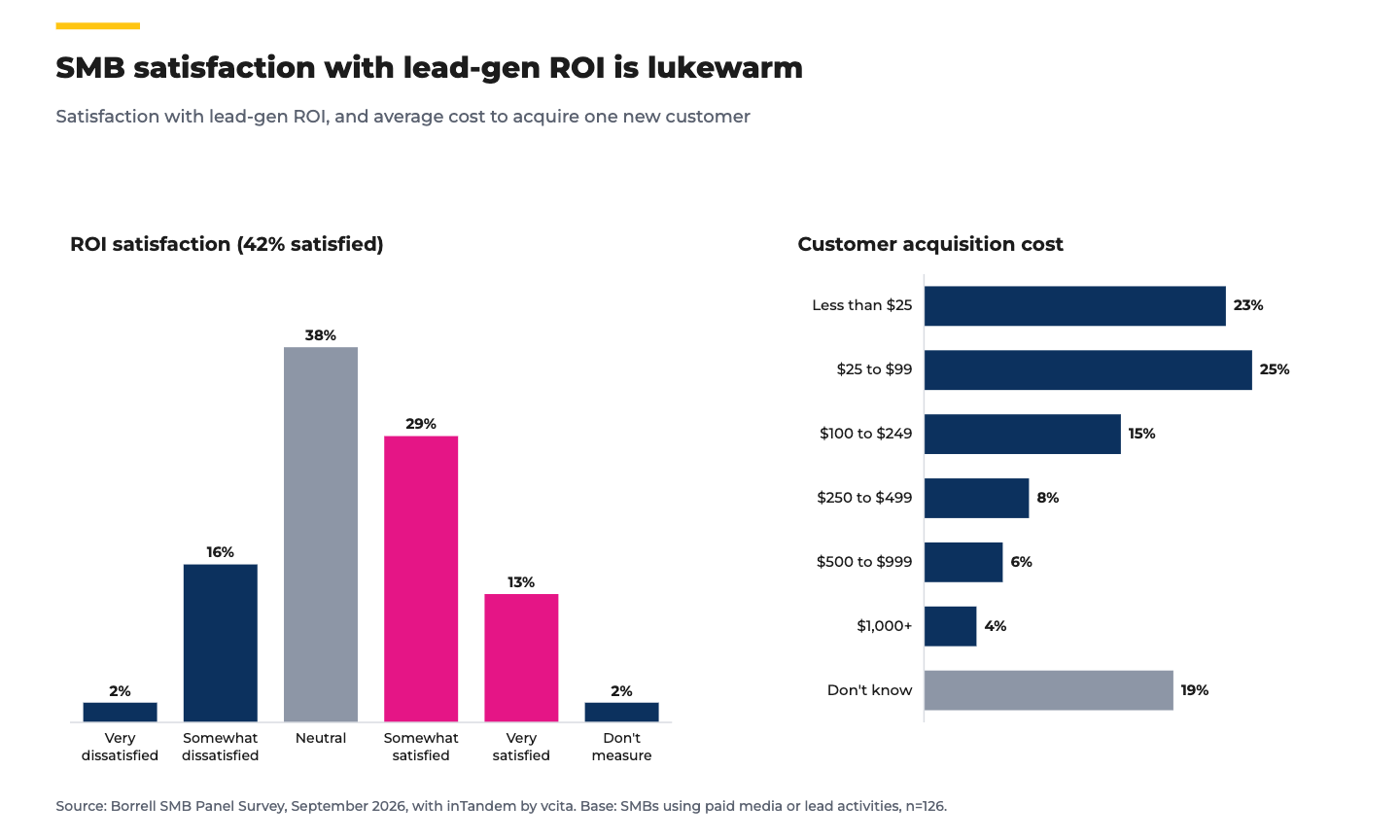
42% of SMBs are satisfied with their lead-gen ROI (29% somewhat, 13% very), 38% are neutral and 18% are dissatisfied. 75% expect lead-gen spending to stay the same over the next 12 months, 17% expect it to rise and 8% expect it to fall.

For most SMBs, acquiring a customer costs relatively little. 48% spend under $100 to win a new customer, 18% spend $250 or more and 19% don’t know their acquisition cost.

Two charts. Lead-gen ROI satisfaction: very dissatisfied 2%, somewhat dissatisfied 16%, neutral 38%, somewhat satisfied 29%, very satisfied 13%, do not measure 2%. Customer acquisition cost: under $25 for 23%, $25-$99 for 25%, $100-$249 for 15%, $250-$499 for 8%, $500-$999 for 6%, $1,000+ for 4%, 19% do not know.

What SMBs want from AI in lead-gen

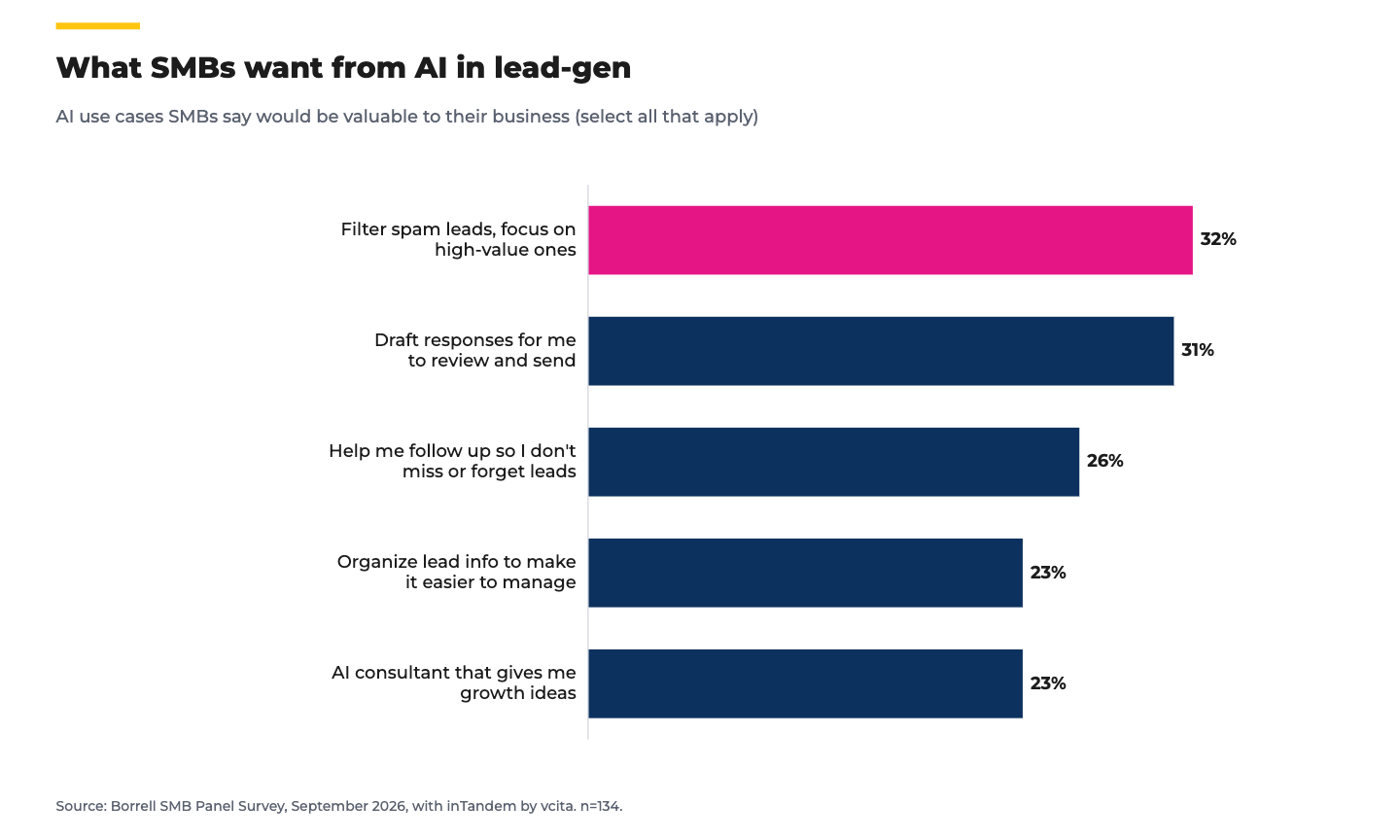
The AI uses SMBs value most are practical: filtering spam leads to focus on high-value ones (32%), drafting responses to review and send (31%), following up so leads aren’t missed or forgotten (26%), organizing lead information (23%) and an AI consultant that suggests growth ideas (23%).

Bar chart of the AI use cases SMBs value most for lead generation: filtering spam leads 32%, drafting responses to review 31%, follow-up reminders so leads are not missed 26%, organizing lead info 23%, an AI consultant for growth ideas 23%.

What this means for media companies and agencies

SMBs are telling the providers that sell them leads what they want: better-qualified leads, clearer measurement and more consistent follow-up. The gap shows up after the lead arrives. The business owner is on a job and misses the call, the lead’s details are hard to get, nobody follows up, and at renewal time the client says the leads aren’t working. The provider gets the blame.

With 38% of SMBs ready to switch for a proven better return, providers that connect the leads they deliver to paying customers have a stronger case than those selling lead volume alone. inTandem’s AI Leads Max answers every lead 24/7 across website, Facebook, Instagram, SMS, WhatsApp and calls, books hot leads and keeps following up, all under your brand, so your advertisers can see what your campaigns deliver.

About the survey

The 2026 Lead-Gen & Conversion Report is based on Borrell’s monthly SMB Panel Survey, fielded September 9 to 30, 2026, with participation from inTandem by vcita. 134 small and midsize businesses completed the survey. Borrell covered the same topic in 2017 and 2022, which allows trend comparisons.

Respondents came from retail (23), arts and entertainment (12), professional and business services (12), health care (11), construction (11), real estate (9), finance and insurance (8), education (7), media or advertising (7), personal care (5) and other industries (27). By US region: West 42%, Midwest 24%, Northeast 19%, South 15%. 42% describe their marketing expertise as novice, 22% as mid-level and 36% as master.

Some questions were asked only of SMBs that use paid media or lead activities (n=120 to 126) or that focus on acquisition (n=121). Each chart notes its base.

How to cite this data: Borrell, 2026 Lead-Gen & Conversion Report (November 2026), sponsored by inTandem by vcita. Get the full report.

FAQs

  • What share of SMB marketing effort goes to customer acquisition in 2026?

    42%. According to Borrell’s 2026 Lead-Gen & Conversion Report, SMBs spent an average of 42% of their marketing effort on acquiring new customers in 2026, up from 35% in 2022. 43% spend more than half their marketing effort on acquisition.
  • How many SMBs have a formal process for managing leads?

    About half. 48% of SMBs that run lead-gen have no formal process for tracking and organizing leads. 32% use a CRM or contact database and 23% use spreadsheets. 25% don’t track where their leads come from.
  • How fast do small businesses respond to new leads?

    72% respond the same day or faster: 16% immediately, 15% within an hour and 41% later the same day. 15% take a few days and 8% have no set process.
  • What happens to leads that reach SMBs after business hours?

    62% of after-hours leads are answered the next business day. Only 13% are answered automatically by a chatbot, autoreply or answering service, 9% go to voicemail with inconsistent follow-up and 2% are usually lost.
  • Which lead sources do SMBs use most, and which bring the best leads?

    Social media advertising is the most used paid source (61%), followed by SEM/Google Ads and SEO (36% each). Facebook is named most often for the best-quality leads (41%), ahead of referral programs (27%), SEM/Google Ads (23%) and Instagram (22%).
  • What is the average lead-to-customer conversion rate for SMBs?

    SMBs report that 41% of leads become paying customers within 12 months on average. Results vary widely, and 21% don’t track conversion.
  • Would SMBs switch lead-gen providers for a better return?

    Yes, many would. 38% of SMBs say they would be somewhat or very likely to switch to a lead-gen vendor or platform that could clearly show a better return. 77% report at least one lead-gen challenge, led by low lead volume (25%) and difficulty measuring ROI (24%).
  • How do SMBs want to use AI for lead generation?

    The most valued AI uses are filtering spam leads to focus on high-value ones (32%), drafting responses to review and send (31%), following up so leads aren’t missed (26%), organizing lead information (23%) and an AI consultant for growth ideas (23%).
  • Where can I get the full 2026 Lead-Gen & Conversion Report?

    You can download the full report from Borrell and inTandem by vcita here. It includes every chart, the full question wording and SMBs’ open-ended answers.

Want to become uncancellable?

inTandem turns the leads you deliver into revenue your advertisers can see.