SMBs are simplifying tech stacks, prioritizing cash flow, and cautiously embracing AI


2026 is finally here and with it comes a fresh wind of unprecedented maturity for the small-medium business (SMB) tech landscape. For years, the SMB ecosystem needed to be educated on the importance of “digital transformation” to survive their new reality. This involved  significant efforts to get unsavvy offline businesses online, which was particularly accelerated by global events (COVID, for one). 

Well, we’re here to report that the education phase is officially over, and we’re headed into a new era. 

Today’s service-based SMB owner is digitally literate, discerning, and increasingly pragmatic. They understand the inherent value that technology offers; they no longer need to be convinced that software can help them run a better business. However, their relationship with that technology is shifting from wide-eyed experimentation to selective optimization.


For the partners who serve this audience such as marketing agencies, telecommunications providers, financial institutions, and media publishers, this shift represents a pivotal moment. Our survey data collected over the last three years signals that small businesses are expecting more from their solutions, leaving vanity metrics behind and focusing on tools that offer stability, efficiency, and sustainability.

We are witnessing a “Great Consolidation.” SMBs are shrinking their tool stacks, yet their expectations of what those tools must achieve are rising exponentially. The tolerance for fragmented tech stack, where a business owner toggles between five different apps for scheduling, invoicing, email marketing, and CRM, is at an all-time low. These disparate systems create data silos and operational friction that a busy business owner simply cannot afford.

Instead, SMBs are leaning heavily toward comprehensive, “all-in-one” solutions that cover the full spectrum of business operations, from payment collection to AI assistance. They are looking for a command center, not a collection of gadgets, and they are willing to entrust this role to the enterprise partners who already provide them with valuable services. 


Cash flow and payments remain the operational backbone of SMB health


Any SMB-serving company that wants to gain and retain a stronger market fit for its solutions must understand that small businesses’ operational reality is largely shaped by a pressing concern: cash flow. It remains the single most significant stressor for business owners and the primary determinant of whether a business survives or thrives.

Year after year, our findings highlight that managing cash flow and the mechanics of payment collection are major sources of anxiety. From the moment a service is booked to the moment the funds hit the bank account, there are often days, if not weeks, of delay caused by manual invoicing, chasing clients for payment, or reconciling different payment platforms.

Consequently, SMB attention is shifting. They are actively seeking out solutions that assist with managing and optimizing these processes. It is no longer enough for a tool to simply “accept a credit card.” Business owners want systems that automate the awkwardness of payment reminders, provide instant visibility into outstanding revenue, and reduce the administrative burden of reconciliation.


The implication for service providers is profound. By addressing the financial nervous system of the SMB, partners can transition from a transactional vendor relationship to a strategic partnership. When a marketing agency or a telco provides the tool that helps a plumber or a consultant get paid faster, they become essential to that business’ survival. The data suggests that SMBs are not only looking for these solutions but are willing to pay a premium for them. 


AI adoption is increasing steadily, but trust, control, and education are critical barriers


Parallel to the consolidation of tech stacks is the steady, albeit cautious, integration of Artificial Intelligence (AI) into the daily workflow of the small business. Similar to the early days of cloud computing or mobile adoption, handing over the torch of AI use to SMBs is proving to be a slower process than many expected, but one that has the potential to bear fruit for those who navigate it correctly.

Two years ago, the sentiment surrounding AI in the small business community was defined by hesitation and skepticism. It was viewed as a “black box,” or worse, a threat to the personalized nature of service-based businesses. Today, we are seeing a marked shift in attitude. The conversation has moved from “Will AI replace me?” to “How can AI help me finish my admin work by 5:00 PM?”


For those SMBs who use it, AI has transitioned from a novelty to a daily utility. The idea of allowing AI to automate routine tasks such as drafting client communications, managing intake forms, organizing schedules, and summarizing customer interactions has become fathomable, and for many, indispensable.

However, providers must tread carefully. “AI for AI’s sake” is failing to gain traction. Simply adding a generative text button to a dashboard does not constitute a strategy. For an AI feature to be adopted, it must bridge the gap between “advanced technology” and “business outcome.” Providers must ask themselves: “Why should my clients use this?” In 2026, the answer must be translated into tangible results: hours saved, leads converted into bookings, or professional communications that help a small team maintain consistency and professionalism.


Furthermore, trust and education remain critical barriers. SMB owners are protective of their client relationships. They need assurance that AI tools will maintain their tone of voice and accuracy. They require guardrails and control. Providers who simply dump AI features on their user base without guidance or human intervention will see low adoption. On the other hand, partners who educate their users and keep them in the driver’s seat by allowing them to approve AI actions will win over the market.


This brings us to the core opportunity for 2026. The organizations best positioned to win are not those offering the flashiest individual features, but those that bundle solutions that enable healthier cashflow along with AI that gradually builds trust into cohesive offerings.


Many service providers admit they struggle to understand the day-to-day needs of their SMB clients. To maximize value in this market, these large organizations must look beyond their traditional services. An SMB wants more than just connectivity from their telco; they want a way to manage the client who calls over that connection. They want more than just a checking account from their bank; they want a way to fill that account with revenue. And they want more than just a spreadsheet of leads from their website, they want a way to convert those leads into paying customers.

Those companies who take a deeper look into their target market’s challenges and goals will see that service-based businesses want it all: lead management, scheduling, payments, and client communication, all wrapped in an affordable, integrated package that includes smart, strategic AI tools. They are simplifying their lives, and they are looking for a partner to help them do it.


Serving the SMB market might feel like a never-ending chase, but this report is designed to take the guesswork out of the equation. We’ve been collecting data from our surveys of 500 US-based small businesses about their digital transformation journeys since 2023. This report will present the data from our most recent survey (Dec 2025) and outline trends and insights from the past 3 years to give service providers a comprehensive analysis of where their efforts would be best invested.

This is a valuable resource for any provider looking to increase revenue, reduce churn, and increase loyalty with their SMB clients.    

 

Survey methodology

The insights in this report come from data we’ve collected throughout our end-of-year surveys between 2023-2025, giving readers a holistic “big picture” of the SMB tech landscape today and how it’s evolved. The most recent dataset, collected in December 2025 through a third party survey company, consists of 500 SMB respondents across the US.


Most respondents are 35+ years old


Age

%

18-24

4.9%

25-30

7.5%

31-36

17.2%

37-45

32.5%

46-50

13.7%

51-64

24.3%


Majority are female:

Male: 42.4%

Female: 57.6%


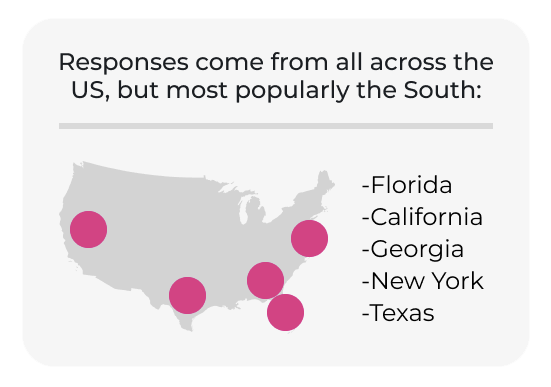
Responses come from all across the US, but most popularly the South:


  • Florida 
  • California 
  • Georgia 
  • New York
  • Texas 


Respondents are all self-employed, either full time or part time:


Full time: 68%

Part time: 32%


Most are running their business themselves or working with extremely lean teams:


Number of employees

%

1

53.8%

2-10

33.4%

11-20

9.6%

21-50

3.2%


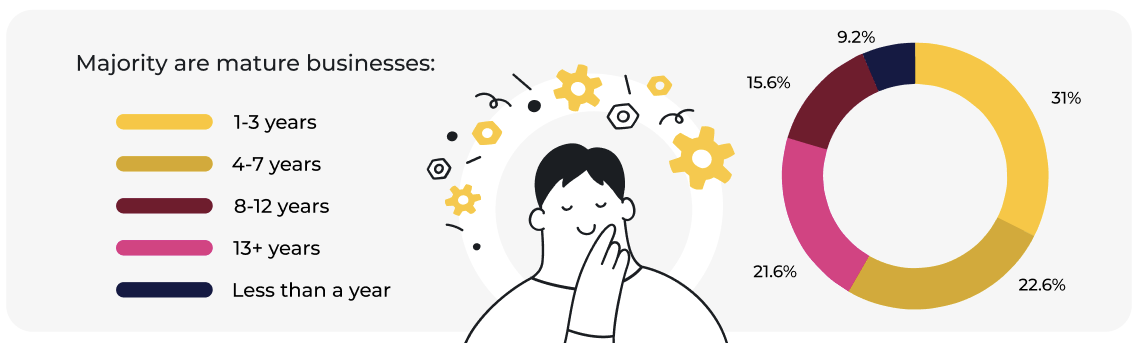
Majority of respondents are mature businesses:

Survey respondents represent varied industries:


Industry

%

Home services & maintenance

21.6%

Retail & E-commerce

16%

Professional, Financial, & IT services

13.8%

Creative, Arts & Media

13.4%

Healthcare, Beauty & Wellness

12.2%

Education & Training

4%

Construction & Trades

3.2%

Agriculture, Food & Beverage

3%

Transportation & Logistics

2%

Real Estate & Property

1.4%

Other

9.4%


Key takeaways

  1. SMBs are no longer in survival mode with 70% describing their business as “stable” or “growing”. 
  2. 42% of SMBs admit they could not survive without their digital tools.
  3. The percentage of SMBs using between two and four tools has dropped from nearly 66% in 2023 to 59% since 2024.
  4. 69% of SMBs are using at least one automation for their operations in order to save time.
  5. A whopping 87% of SMBs use automation for their billing, invoicing, and payment collection.
  6. 38% of SMBs plan to improve their payment collection this year.
  7. 40% of SMB AI users use it on a daily basis to impact their business. 
  8. 68% of users prefer to extensively test AI before letting it run autonomously.
  9. Lack of needed features was the top reason for SMBs who switched providers in the past year. 
  10. 43% of SMBs would pay more for a solution if it reduced the total number of tools they use. 


Section 1: Are SMBs still in survival mode in 2026?


For the better part of the last five years, “survival” has been the default operating setting for small business owners. Between a global pandemic, supply chain fractures, and inflationary pressure, the narrative surrounding the SMB economy has been one of resilience in the face of crisis.


However, as we analyze the data entering 2026, a different picture is emerging. SMBs are no longer scrambling just to keep the lights on. In its place, we are seeing a stabilized sector that is heavily reliant on digital tools for success.


Small businesses have officially bounced back


The most significant finding from our 2025 End-of-Year Survey is the sheer drop in “survival mode” sentiment. When we asked 500 service-based SMB owners to describe their current business health, the vast majority indicated they have moved beyond critical condition. 70% indicated that their business was either “stable” or “growing”, and only 15.6% reported being in “survival mode”.

To put this into perspective, this represents a significant improvement in sentiment compared to, a KeyBank survey conducted earlier in 2025 found that nearly 1 in 4 SMBs (approximately 25%) felt stuck in survival mode and unable to reach stability, let alone growth.


The discrepancy between these figures suggests that the market is stabilizing faster than anticipated, or perhaps more accurately, that the businesses remaining are those that have successfully adapted to the new normal. Service providers targeting this audience should take note that they are no longer selling to a desperate audience trying to stop the bleeding. They are selling to a stabilized audience looking to secure their footing and expand.


Digital adoption is the primary driver of stability


This shift from survival to stability is not accidental, nor is it solely due to improved macroeconomic conditions. The data indicates small businesses have their digital tools to thank for much of this newfound ground as respondents revealed a direct correlation between digital maturity and business confidence.

The frantic digitization of 2020–2022 has matured into a steady operational reliance with 41% of SMBs agreeing that their business tools have set them up for success. Owners are no longer buying software just to “go digital”; they are using it to build a defensive buffer around their operations.

In addition, when nearly half (42%) of our SMB respondents admitted they could not survive without their digital tools, those tools cease to be “value-added services” and become critical infrastructure. This level of reliance is the “stickiness” most service providers seek.


This sentiment is further emphasized by the U.S. Chamber of Commerce Empowering Small Business Report 2025. The data found that there is a clear performance gap based on tech adoption: 84% of businesses with high technology adoption experienced sales growth over the past year.

The message is clear: Digital tools are no longer optional “nice-to-haves.” They are the primary differentiator between businesses that are growing and those that are merely existing.


SMB digital maturity is fueling investment


Because SMBs that use digital tools have understood the value they offer their business, they have become more willing to invest in solutions in the future, as indicated by over 45% of SMBs who plan to increase their budgets for digital solutions in 2026. 

This willingness to spend is not frivolous. It is calculated. SMBs are looking to reinvest their revenue into tools that promise efficiency. They are looking to automate the mundane so they can focus on the strategic. They are, in essence, trying to buy back their time.


However, knowing that they are spending is only half the battle. The more important question for a provider shaping their 2026 roadmap is: What exactly are they buying?


Section 2: The state of SMB digital adoption in 2026


In 2026, that increased budget will be going to solutions that consolidate, optimize, and provide undeniable value.  

The data confirms that digital adoption is no longer much of a hurdle to be cleared. An impressive 82% of our survey respondents currently use at least one digital tool to run their business operations. This aligns with broader market trends reported by the U.S. Chamber of Commerce, which found that 84% of small businesses plan to increase their use of technology in the coming year. 


Though digital adoption in the SMB market remains high, we have noticed a much more focused, mature approach. The percentage of SMBs using between two and four distinct tools to run their business has dropped from nearly 66% in 2023 to plateau at 59% since 2024.

This downward trend is not a sign of digital regression; rather, it is indicative of a more selective, knowledgeable market. Small businesses remain dependent on digital tools to optimize their operations and processes, but they are cherry-picking the platforms that earn a permanent place in their workflow. 


The evolution of intent: From tasks to growth


What hasn’t hit a downward trend, however, is SMBs’ expectations from their digital solutions. In the past, tools were adopted to handle isolated tasks like sending an email or processing a card. Today, expectations have evolved. 

When we analyze the top uses for digital tools, the hierarchy of needs tells a compelling story about the modern SMB mindset. Consistently taking first place since 2023 is collecting payments, with 52% of respondents citing it as their primary use case in 2025. This underscores the enduring truth that for a small business, cash flow is oxygen. Any provider looking to serve this market must recognize the incredible importance of assisting with the friction of getting paid.

However, the most dynamic shift appears in the second-ranked priority: growing the business. Cited by 48% of respondents, this objective has climbed steadily up the ranks, rising from the fourth choice in 2023 and the third in 2024. Business growth is no longer just a vague goal; it is a specific expectation SMBs have of their software. This explains the urgent drive for consolidation. By integrating systems (linking payments to client records and marketing) business owners can own more processes in one place. This centralization offers a better, more holistic picture of their business, leading to smarter decision-making and, ultimately, the growth they are prioritizing.


Following closely behind is marketing, cited by 44% of respondents. This is a critical pain point, as marketing tasks consumed the majority of time for 26% of SMBs in 2024. These business owners know how to provide exceptional customer service, which is why consumers prefer them over impersonal chains. But being a great plumber or consultant does not mean one knows how to market a business, which explains why they are in desperate need of tools that alleviate this burden. 

The final 2 most popular uses for digital tools in this sector are organizing client information (40.3%) and attracting more customers (40%). The major trend to be noted is the demand for solutions that streamline operations, not just tools that add to the noise.


The “All-in-One” mandate for providers


To better serve this market, there is a need for service providers to adapt their strategies and think outside the box, even if it means expanding their proposition beyond their traditional suite of services. It is getting clearer that continuing to offer separate solutions that only cover one aspect of business operations leaves these providers at risk of losing their share.


An overwhelming majority (well over 50%) of our survey respondents indicated that they would be more likely to purchase an all-in-one solution than pursue separate tools. This preference is so strong that it overrides price sensitivity. In fact, 43% of respondents said the ability to reduce the total number of tools they are currently using would make them more willing to invest in new solutions at a higher cost.


SMBs are time-starved, resource-limited, and exhausted by juggling their entire business operations across multiple logins. If a service provider can free up their time by bundling value-added services into one cohesive package, they are likely to increase loyalty and significantly reduce churn. 


The 2026 SMB digital solution wishlist

It is important to clarify that when SMBs ask for “growth” tools, they are not solely asking for more leads. They are looking for tools that help them run, manage, and grow their business, and their inability to find those solutions leads to churn. In fact, 21% of respondents revealed they are often frustrated with their existing technology’s limitations.


So, what does the ideal tool look like to them? We asked SMBs to list their most wanted services, and the results reflect a desire for administrative relief. Billing and invoicing remains the top requested feature year-over-year, followed closely by payment collection. This consistency reinforces that financial operations are the bedrock of the SMB tech stack.

However, we are seeing new priorities emerge that highlight the desire for efficiency. Automated reminders have climbed from not even ranking in the top five in past years to now sitting as the third most requested capability. This speaks to the “time is money” reality of small businesses; they want technology to ensure their clients show up. Following this are scheduling and, notably, AI capabilities.


The emergence of AI in the top five requests signals that SMBs are ready to embrace intelligent automation, provided it is practical. They want their tools to be smart enough to remind a client of an appointment, send an invoice automatically, and perhaps even draft a reply to an inquiry, not more one-off services. The companies that can deliver this “business in a box” experience will be the ones who define the market in 2026.


Section 3: Where will SMBs spend their attention (and their money) in 2026?


For enterprise partners serving small businesses, understanding the specific investment priorities of the market is critical for roadmap planning. The “all-in-one” solution that wins in 2026 will be defined by three distinct value pillars: Automation, Payments, and Artificial Intelligence.


Automation as an infrastructure


For the modern service provider, automation has graduated from feature SMBs might have used to a fundamental infrastructure requirement. The driving force behind this shift is the “time economy.” For a lawyer, a roofer, or a fitness coach, time is the absolute ceiling on revenue. Therefore, any tool that can demonstrably reclaim billable hours is viewed not as a smart and valuable investment.

According to our findings, automation adoption has reached a critical mass, with 69% of respondents currently utilizing at least one form of automation to run their business. This high rate of adoption suggests that the market is now comfortable with the concept of “set it and forget it,” provided the outcomes are reliable.


When we analyze where this automation is being deployed, the data points to a prioritization of financial and administrative stability over creative tasks. Billing and invoicing (46%) & payment collection (41%) are the most widely automated. Marketing automation (36%) and scheduling (33%) round out the top four, indicating that once the money is secured, the focus shifts to sustaining the pipeline and managing logistics.


The return on investment for these tools is quantifiable and significant. Our survey respondents revealed that digital tools and automation save up to 156 hours per year for nearly half of the market (47%). More strikingly, approximately 34% of SMBs report saving up to 364 hours annually, effectively granting the business owner an extra month of productivity a year. This potential for time reclamation is the strongest selling point a partner can offer. In fact, using automation to reduce workload was cited as the top area of interest for 29% of SMBs, making them willing to spend more on tools that offer them. 


Payments: The non-negotiable core of the stack


Throughout our years of data collection, the importance of billing, invoicing, and payment collection has remained the singular, recurring theme of SMB digital adoption. With cash flow consistently ranking as the top concern since 2023, and nearly 40% of businesses reporting issues with late payments in 2025, the tolerance for friction in the payment cycle has evaporated. Considering this, it should be no surprise that payment collection tools take precedence over almost every other category of software.


The ability to manage expenses and save money in the long term would drive 44% of SMBs to spend more on a tool. Furthermore, 38% of business owners explicitly indicated that they plan to improve their payment collection processes in 2026. This data exposes a clear mandate to move beyond basic transaction processing and offer comprehensive “financial health” suites.


By solving the pain of late payments and manual reconciliation, a provider moves from being a vendor to a partner in solvency. If a small business has to choose between a platform that offers marketing services and one that ensures they get paid on time, they will invariably choose the latter. Therefore, addressing the “service-to-cash” cycle prevents these companies from leaving the door open for a competitor to capture their client’s loyalty.


An AI shift to daily utility


Perhaps the most dynamic evolution in the SMB landscape is the adoption and implementation of AI for small businesses. We are witnessing a rapid increase, with usage rising from 31% in 2023 to 33% in 2024, and hitting an incredible high of 45% in 2025 (a 36% increase). An additional 45% of respondents have indicated their intent to begin using AI this year.

More importantly, AI usage is transitioning from experimental tinkering to ingrained habit. Of the 45% of business owners who currently use AI, 40% admit to using it at least once a day to impact their business operations. 


The uptick in usage is also reflected in their understanding of the potential impact. A resounding 81% of SMBs agree to some degree that AI will save their business hours each week on administrative and repetitive tasks, allowing them to focus on strategic growth, representing a 21% increase from a Verizon survey conducted earlier in 2025. A jump of this magnitude in such a short window indicates AI is becoming a necessity. This realization is fueling investment, with Salesforce reporting that 71% of SMBs plan to increase their budgets for AI investment in the coming year.

However, for enterprise partners looking to deploy AI solutions, the nuance lies in the balance between trust and control. While 72% of SMBs state they trust AI to automate business tasks, they are not yet ready to hand over the keys entirely. 59% of users are more comfortable using AI when they can approve every action, and 68% prefer to test AI extensively before allowing it to act autonomously. This suggests that the winning AI interface for 2026 will be a “copilot” model that drafts, suggests, and organizes, but waits for human sign-off before execution.


Keeping the human-in-the-loop becomes even more crucial as SMBs begin to use AI in more “sensitive” business aspect. While early adoption focused on content generation, the top intended uses for 2026 are deeply operational. Drafting communications (33%) and general business administration and organization (31%) top the list, followed by scheduling (28.4%), answering client messages (28.2%), and drafting estimates (27%).

These priorities reveal that SMBs are implementing AI in areas where they can maximize professional perception and operational excellence. They are using it to communicate more articulately with clients, to ensure their files and tasks are organized, and to handle the mundane back-and-forth of scheduling. 


Section 4: What does this mean for SMB service providers?


The shift in the digital landscape for small businesses creates a dual reality for service providers: an abundance of new opportunity paired with significantly increased competition. For years, SMBs have asked for a more consolidated tech stack, but in 2026, they are finally putting their money where their mouths are. 


For the giants that serve this market, the implication is clear: you can no longer compete on fragmented services that SMBs can readily find elsewhere. The “stickiness” of the future lies in operational integration. Based on the data and insights we have collected, the following strategies outline how service providers can secure their position as indispensable partners in the modern SMB economy.


Bundle outcomes, not tools


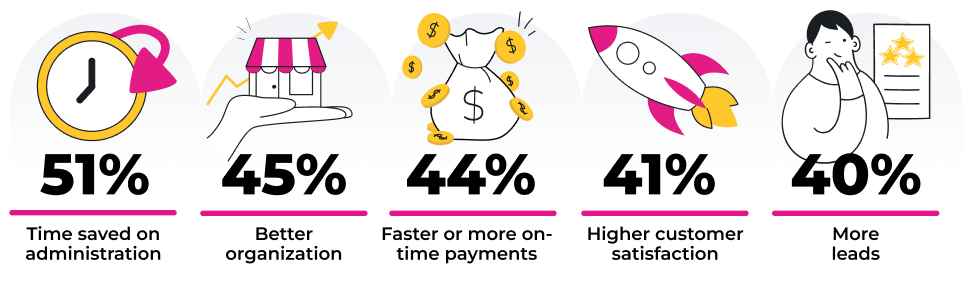
The most critical adjustment for enterprise partners is a shift in messaging and product packaging. SMBs are no longer buying “tools”; they are buying results. When we asked business owners to rank the top results their digital tools have helped them achieve, the answers were strategic and operational:

  1. Time saved on administration (51%)
  2. Better organization (45%)
  3. Faster or on-time payments (44%)
  4. Higher customer satisfaction (41%)
  5. More leads (39.8%)

It is telling that “more leads” (often considered the holy grail of SMB marketing) ranks fifth, behind operational efficiencies like saving time and getting paid. This signals that SMBs will not settle for less than comprehensive operational support nor entertain any provider that does not speak this language.

For example, simply adding AI to a product roadmap for the sake of checking a box is unlikely to yield adoption. In fact, when asked to list considerations for choosing new digital tools, AI capabilities ranked lowest in importance (3.24 out of 5). This is not a rejection of AI, but a rejection of technology without purpose.


To capture attention, providers must address the specific anxieties that keep business owners awake at night. The top challenges for SMBs in 2025 included increasing sales (22%), attracting new customers (19%), and managing business costs (17%). Looking ahead to 2026, the top concerns have sharpened: cash flow dominates at 38%, followed by attracting new customers (33%) and time management (23%).


The lesson is straightforward: SMBs do not care about what your tool can do; they care about what your tool can do for them. They will adopt technology only when it demonstrates a clear ability to improve operations, stabilize cash flow, or deepen customer relationships.


Address their cash flow concerns


If cash flow is the primary source of anxiety, it must be the primary focus of the solution. Adding payment collection capabilities is no longer a “value-add”, in 2026, it is a necessity. With 37% of SMBs admitting that some, most, or all of their payments are late, the migration to tools that solve this problem is seemingly inevitable.


However, a basic “pay now” button is insufficient. SMBs have understood the need for accepting varied payment methods to streamline collection, meaning a basic tool will not cut it in 2026. The top payment methods currently in use include online checkout (43%), payment links (42%), peer-to-peer payments like Venmo or Zelle (40%), ACH/Bank Pay (38%), and tap-to-pay (36%).


By integrating these diverse payment rails, service providers can prove ROI in a way that vanity metrics cannot. Instead of reporting on “clicks” or “impressions,” a provider can report on “revenue collected.” This shift towards verified income allows the provider to track the actual financial health of their client, creating a data loop that reinforces the value of the partnership.


Position AI as assistive, not autonomous


While the industry buzzes about autonomous agents, the SMB market remains cautious. Their comfort levels with AI adoption strongly favor a “human-in-the-loop” approach. While one in four SMBs use AI a few times a day, only 9.6% are very comfortable allowing it to act autonomously without approval and 32% somewhat agree that AI will never be able to properly execute tasks without human intervention.


However, there is a path forward. 68% of respondents indicated they would want to be involved initially, but once they see the technology is reliable, they would gladly step away. This suggests that adoption is a journey of trust-building.

Furthermore, the intended use cases for AI are evolving into strategy-oriented processes rather than just quick execution. The top intended uses include drafting communications (33%), business administration and organization (31%), scheduling (28.4%), answering client messages (28.2%), and drafting estimates (27%).


To encourage adoption in this sector, providers must focus on training and education (cited by 27% as a key driver), demonstrating use cases of similar businesses (17%), and providing better privacy clarity (16.6%). As AI remains a relatively abstract concept for many, showing how a similar business successfully used the tool is more powerful than a feature list. Additionally, with 63% of SMBs worried about AI opening their business to fraud, safeguarding data and being transparent about privacy is non-negotiable.


Reduce friction through consolidation


The most actionable insight for 2026 is the overwhelming desire for simplicity. Most SMBs would jump at the chance to use a single tool that manages their entire operation rather than tracking multiple dashboards. The downward trend in the size of the tech stack proves the “app fatigue” SMBs are experiencing. This is further evidenced by the fact that 35% of SMBs switched tools in the past year, with top reasons being a lack of needed features (21%) and the explicit need for an all-in-one solution (18%).


This does not mean providers need to overhaul their core services. A telco does not need to build a CRM from scratch; an agency does not need to code a scheduling engine. Instead, they should find a way to convert their scattered solutions into an all-in-one offering through strategic partnerships.


The migration to this new system must be low-risk and seamless. Two of the biggest challenges for SMBs when adopting new tools are the learning curve (27.6%) and adapting workflows (14.8%). Consequently, ease of use was rated 4.37 out of 5 in importance (the second highest choice) when considering a new tool.

Service providers must anticipate these complexities. Success requires investment in in-product support, tutorials, and knowledgeable customer support. The barriers to effective use are often educational; learning curve (25%), time (19%), and lack of training (18.6%) are the top factors limiting effective tool usage. Mastering the onboarding experience is the golden ticket. Once an SMB runs their entire business through your solution, the cost of switching becomes quite high, significantly reducing churn.


Use SMB data to personalize value delivery

The “one size fits all” era is over. Each small business’ vertical, size, and location requires a strategy tailored to its specific needs. A beauty salon requires features that cater to walk-ins and in-person payments, whereas a local accountant needs secure document sharing and strict appointment adherence, for example.

Gaining data about their business allows service providers to better tailor solutions. By providing a platform that handles core operations such as scheduling, payments, and client management, providers gain visibility into usage patterns that can drive intelligent cross-sell and up-sell strategies.


For example, a provider could use trigger-based recommendations: “You sent 20 invoices this month. Add payment links and automated reminders to reduce late payments.” Alternatively, they could offer industry-specific benchmarks: “Businesses like yours typically save 4–7 hours per week once online booking is enabled.” This personalized approach shifts the relationship from transactional to advisory.


Do it all at an affordable price


Finally, the economic reality of the SMB sector cannot be ignored. These businesses do not operate with enterprise-sized budgets. They face fluctuating revenue and are often run by small teams that cannot afford to hire administrative help. In fact, financial instability is the top reported barrier holding back 24% of SMBs from growth. Unsurprisingly, price is the top consideration when choosing a digital tool, and staying within budget is the top challenge (28%) SMBs have when building their tech stack. This data further emphasizes the imminence of bundling solutions at an affordable price, as consolidation is not only a strategic move, but also a way of escaping “survival mode”.

How can an enterprise provider offer a comprehensive, all-in-one suite at a price point that makes sense for a yoga instructor or a landscaper?


The answer often lies in the “build vs. buy vs. partner” decision. Developing a comprehensive business management platform in-house is a massive undertaking full of risk (especially if all-in-one is not their forte), high costs, and a slow time-to-market. Acquiring a tech company offers more control but comes with significant integration headaches and capital expenditure.


Partnering with a knowledgeable SMB tech company emerges as the most logical, low-risk path. Through partnership, providers can bundle solutions, which allows them to defend a higher price point by offering immense aggregate value while also reducing churn. An SMB might cancel a standalone email marketing tool to save ten dollars, but they are far less likely to rip out the operating system that runs their schedule, payments, and client communications. By delivering a white-labeled, integrated experience, providers can offer the affordability SMBs need with the profitability their shareholders demand.


Wrapping up: How to win over SMBs in 2026


As 2026 begins to unfold, the data delivers a verdict that is both encouraging and demanding. The era of “digital education” is officially behind us. We are no longer convincing small business owners of the internet’s utility or the necessity of software. The service-based SMB of 2026 is digitally literate, operationally stabilized, and discerning. They have graduated from the scramble of survival mode and are now focused on a new hierarchy of needs: stability, efficiency, and growth.


For the enterprise partners serving this ecosystem, this shift represents a profound changing of the guard. The “Great Consolidation” we are witnessing is not merely a trend; it is a plea for sanity. SMBs are rejecting the noise of isolated gadgets in favor of a centralized command center that handles critical business operations like scheduling, invoicing, client communication, and payments. 

This report highlights that the partners who win in 2026 will be those who listen to the specific needs of their clients. While the industry buzzwords might be “disruption” or “generative AI,” the SMB owner’s reality is grounded in “cash flow” and “time management”. 


The mandate for service providers is clear: stop selling tools and start selling outcomes. The market is healthy, and budgets are increasing for solutions that prove their worth. 

By bundling payments, software, and trusted expertise into a cohesive, white-labeled offering, enterprise providers have the rare opportunity to become the “financial nervous system” of their clients. The technology is available, the demand is explicit, and the market is waiting. 


Get the full report here